
From The Classroom to The Final Four
AU Students Enjoy March Madness and Take on the NCAA Analytics Challenge
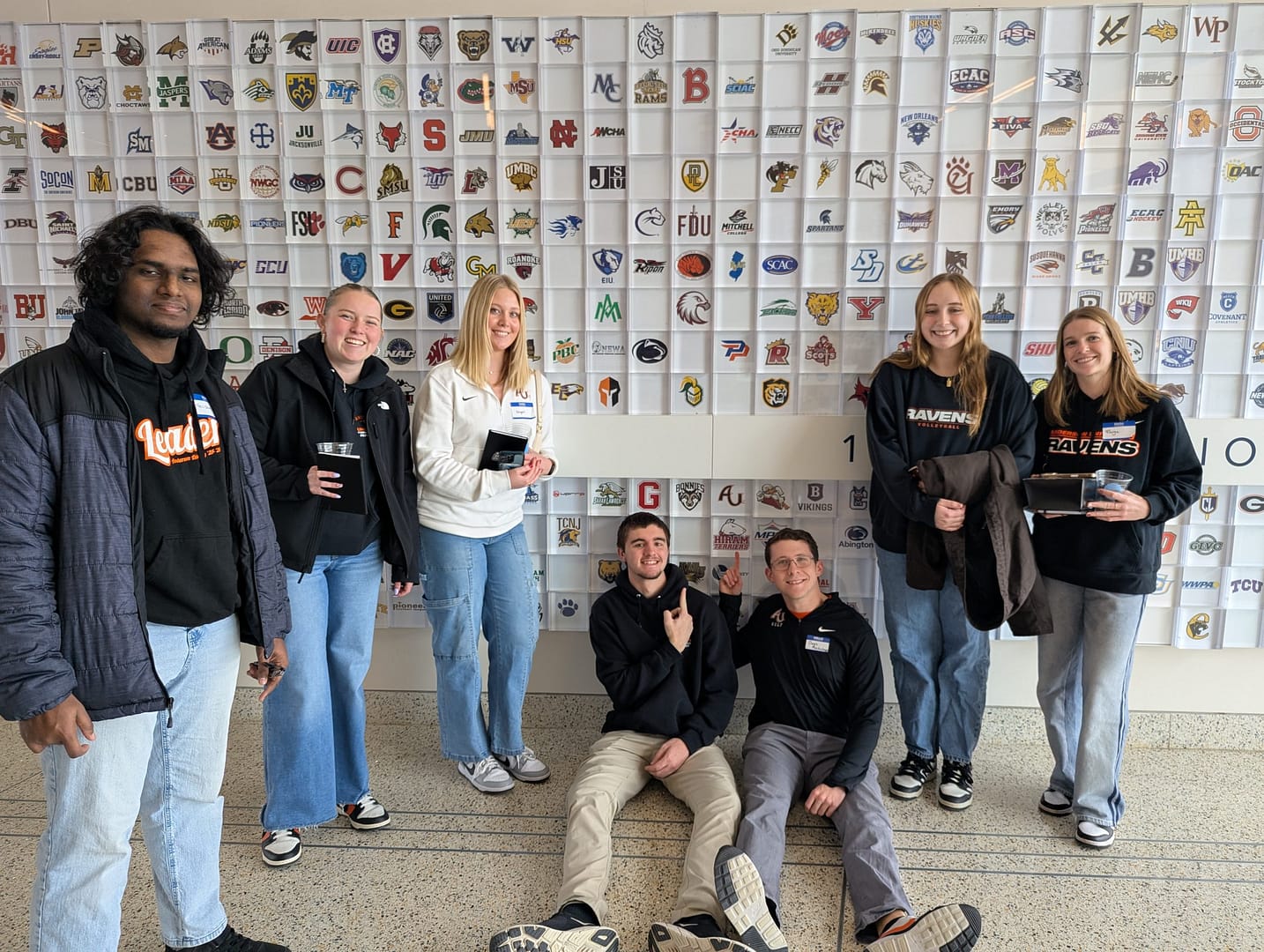
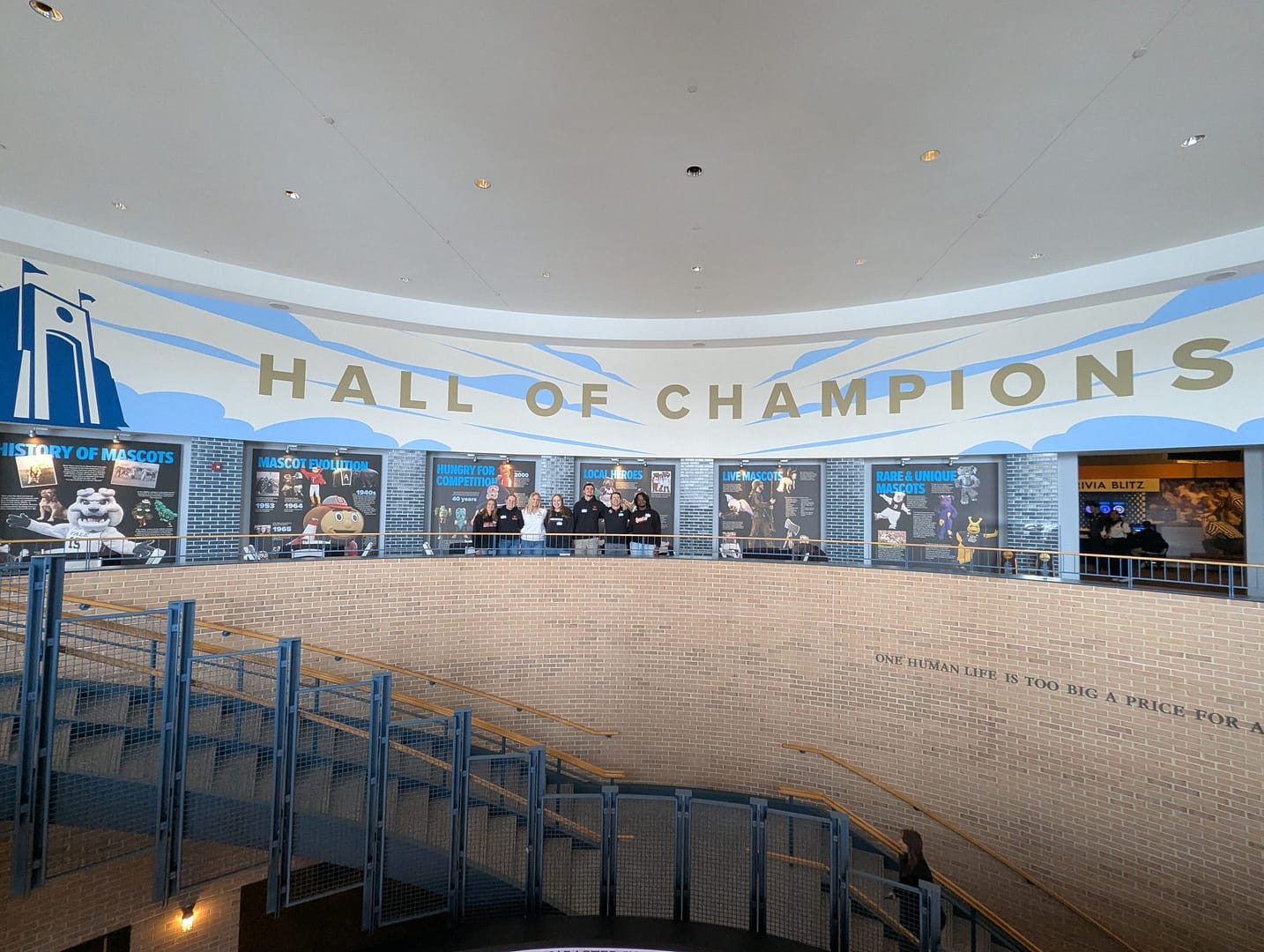
Standing inside the NCAA Hall of Champions in Indianapolis, just weeks before the Men’s Final Four, Anderson University students were not just taking in the history of college basketball.
They were preparing to compete.
As part of the NCAA Analytics Challenge, AU students across various technology majors applied machine learning, data science, and business strategy to solve a real-world problem. Their task was to predict how the NCAA Selection Committee ranks all 68 teams in the men’s basketball tournament.
To do that, teams worked with five years of historical data across NCAA Division I programs, analyzing everything from win-loss records and scoring averages to advanced rankings from the NCAA Evaluation Tool (NET) to identify trends and outliers. They were encouraged to test boundaries and think outside the box by augmenting their datasets with additional variables, such as the ratio of returning players to transfers and the amount of NIL money spent.
It is a challenge that blends technical skill with creativity and places AU students alongside peers from top institutions across Indiana. AU students competed with leading Indiana institutions, including Ball State University, Butler University, DePauw University, the University of Evansville, Franklin College, Hanover College, Indiana State University, Indiana University, IU Indianapolis, Purdue University, Trine University, the University of Indianapolis, Valparaiso University, Rose-Hulman Institute of Technology, Wabash College, Purdue University Fort Wayne, and the University of Notre Dame.
Because the competition was limited to NCAA institutions, Anderson University was the only participant representing Indiana’s six Council for Christian Colleges and Universities (CCCU) member schools.
A Real-World Challenge
The Final Four Analytics Challenge, hosted in partnership with the NCAA and Butler University, brings together undergraduate and graduate students to tackle complex problems using advanced analytics. In 2026, the competition expanded to include all NCAA Division I, II, and III schools in Indiana, with approximately 750 students participating.
The structure mirrors real-world data science work. Students build machine learning models, refine and forecast outcomes, and communicate results through business reports and visualizations. Top teams advance through multiple rounds, culminating in final presentations just before the national championship game.
Built Into the Classroom
At Anderson University, participation in the challenge is not extracurricular. It is embedded directly into the curriculum. Students enrolled in CPSC 3540, Introduction to Machine Learning, complete the challenge as their semester project. Working in teams, they design, test, and refine predictive models.
“Experiences like this are where everything comes together for students. They’re applying machine learning, working with real data, collaborating across disciplines, and communicating their results. Those are the exact skills they’ll need in their careers.”

Dr. Matthew Preston
Assistant Professor of Computer Science
“Experiences like this are where everything comes together for students,” said Dr. Matthew Preston, assistant professor of computer science. “They’re applying machine learning, working with real data, collaborating across disciplines, and communicating their results. Those are the exact skills they’ll need in their careers.”
Students from across disciplines joined the effort, including majors in computer science, cybersecurity, business analytics, engineering, and physical sciences. That interdisciplinary approach reflects how real-world data problems are solved, not in isolation, but through collaboration.
Learning Beyond the Model
While the challenge emphasizes machine learning and analytics, students quickly discovered that technical skill alone is not enough. At the Tip-Off Event, students heard from industry professionals and NCAA leaders about the importance of context, creativity, and curiosity in solving complex problems.
“The speaker exposed me to how ideas, confidence, and persistence are important in life and how they shape how I view learning,” reflected Nelson David Paul, a junior double major in computer science and mathematics.
“I enjoyed hearing how understanding the context of the problem is the skill that separates you more so than actually building the models themselves,” said Owen Mockabee, a senior double major in business analytics and data science, captain of the men’s golf team, and co-leader of AU’s Fellowship of Christian Athletes chapter.
For many students, the experience reframed how they think about their field. It is not just about building models. It is about solving meaningful problems.
A Team Advances
As the first round concluded in mid-March, Anderson University advanced one team to the semifinals, “Three Uncs and a Dream.”
The team, Hudson Conkling, Luke LeBourdais, Owen Mockabee, and Micah Powell, continued refining their model while translating their technical work into a business-focused presentation and video.
“This was the first time we were working with a real client problem at this level,” said team captain, Owen Mockabee. “It pushed us to think beyond just building a model and really understand what the data was telling us and how to communicate that clearly.”

Owen Mockabee
Business analytics and data science major
“This was the first time we were working with a real client problem at this level,” said team captain, Owen Mockabee. “It pushed us to think beyond just building a model and really understand what the data was telling us and how to communicate that clearly.”
This experience proved valuable as students worked through the full lifecycle of a data science project, from raw data to model development to communication, mirroring the expectations they will encounter in their careers.
Why It Matters
Experiences like the NCAA Analytics Challenge are increasingly critical in preparing students for careers in technology.
In fields like artificial intelligence, cybersecurity, and data science, success depends not only on technical ability but also on problem-solving, communication, and adaptability.
This challenge required students to apply machine learning techniques to large, real-world datasets, interpret and model complex systems, communicate findings clearly, and collaborate across disciplines.
It also introduced students to industry tools and practices, including data visualization platforms such as Tableau, as well as opportunities to engage with analytics professionals.
A Growing Opportunity
The NCAA Analytics Challenge is expected to continue expanding, with plans for regional and potentially national competition in the future.
For Anderson University students, participation represents more than a single event. It reflects a broader commitment to experiential learning, where classroom knowledge is tested, refined, and applied in real-world contexts.
It also signals something larger.
Students at AU are not just learning about artificial intelligence, data science, and cybersecurity; they are also learning how to apply these fields to real-world problems. They are using those tools to solve meaningful problems, collaborate across disciplines, and rise to the demands of careers in a rapidly evolving field.
As the competition grows, so does the opportunity. And for these students, the work is just beginning.
Written by Mischon Hart ’07 | God Bless, Go Ravens!
About Anderson University
Anderson University educates students for lives of faith and service, offering more than 50 undergraduate majors, 30 three-year degrees, 18 NCAA Division III intercollegiate sports, alongside adult, graduate, and online programs. The private, liberal arts institution is fully accredited and recognized for excellence in business, computer science, cybersecurity, engineering, music, nursing, psychology, social work, and teacher education programs. Established in 1917 in Anderson, Indiana, by the Church of God, the university remains committed to its Christ-centered mission.
