
Called to Serve
One Student’s Journey to Law School Through Anderson University’s Pre-Law Program
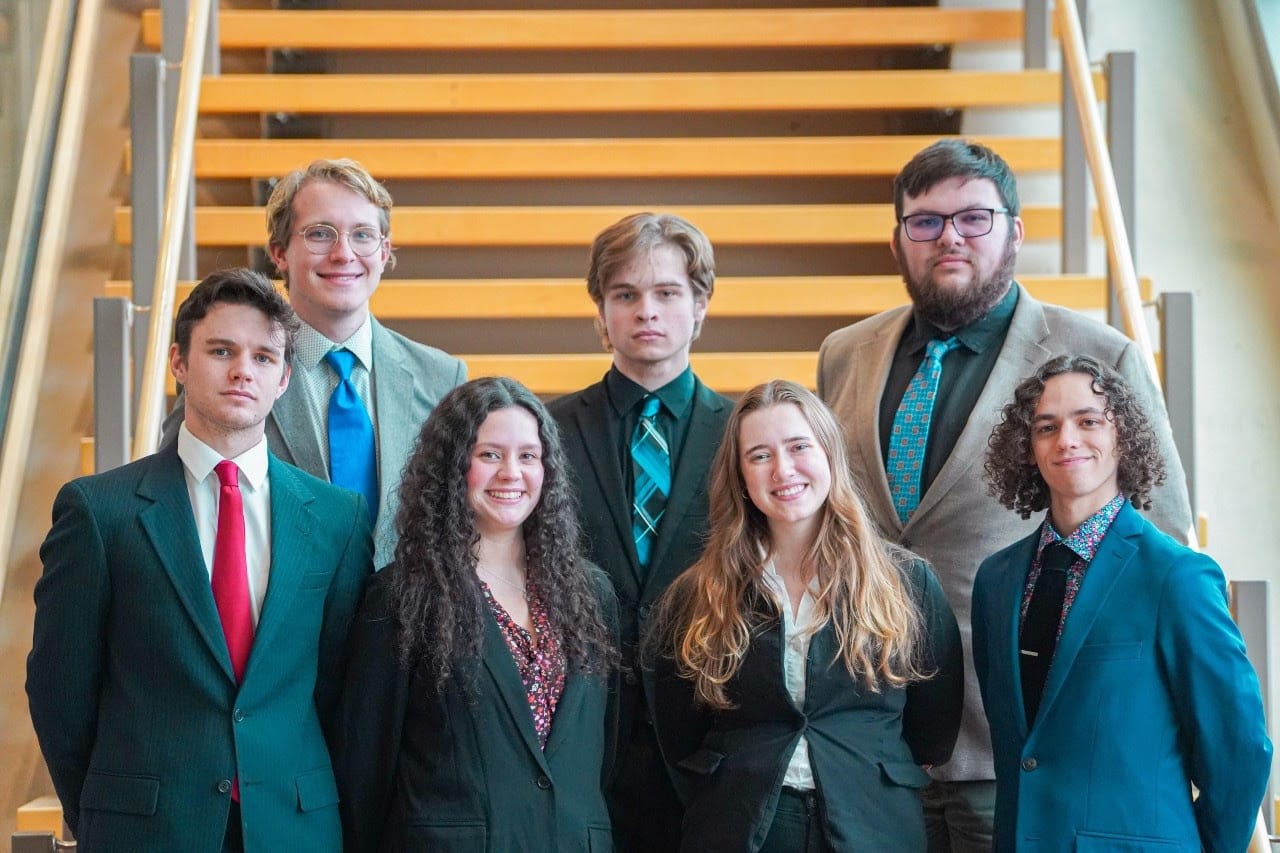
Josiah Zaragoza didn’t dream of attending law school when he first set foot on Anderson University’s campus.
In fact, if you asked incoming freshman Zaragoza why he was attending AU, he would’ve talked about his eagerness to study mechatronics at the same school his mother attended—the only university to which he applied, and one of only two colleges in Indiana offering mechatronics at the time.
Imagine how shocked he’d be to learn that, come this May, he’ll be graduating with a degree in political science, philosophy, and economics, and looking forward to attending Indiana University McKinney School of Law part-time in the fall.
It was a pivot Zaragoza didn’t see coming, but it was one rooted in a deep passion that had been brewing. He made the leap from objective formulas and black-and-white answers to wading through the often-messy waters of subjectivity and grey areas.
“In engineering, you have a problem, and you fix it, and that’s it,” said Zaragoza. “Societal issues are a lot more complex than just having a solution.”
Though a student of political science, Zaragoza didn’t see himself going down the pre-law route until his junior year. He said the decision to pursue law school was a culmination of many things, including deep conversations with Dr. Michael Frank, professor of political science.
“We’ve just had a lot of conversations after classes where we really connect about general ideas and thoughts about government and how it should be, and just what our role in humanity and society is, of helping your neighbor,” said Zaragoza. “One of the biggest things I always focus on is that public office, it’s supposed to be a public servant.”
Being a “public servant” is something Zaragoza had the opportunity to put into practice on campus—not only through the general service-oriented curricula of his classes, but also in more hands-on ways as a student leader in the Student Government Association. He also served as a resident assistant and a member of the International Student Association.
“That, combined with Dr. Frank being always a great support for me, kind of gave me the impetus of ‘I can actually do this,’” said Zaragoza. “Law school or the LSAT always seems so … ‘only very smart people can do it.’ I won’t say I’m not smart. It’s just I consider myself a normal person, so just having that support of, ‘Oh, I can do this—this is not something out of my reach.’”
That growing confidence would soon be put to the test—literally—when Zaragoza sat down to take the Law School Admission Test (LSAT), the standardized entrance exam for law school.
“I just kind of said, ‘If I get a score that gets me into (IU) McKinney (School of Law) … I’ll go to law school, and if I don’t, then I’ll just take it as a sign that I’m not meant for law school,” said Zaragoza. “I just kind of prayed the day before and I was like, ‘God, if this is what you want me to do, then let me get a good score.’”
God answered that prayer; Zaragoza’s LSAT score got him into the law school of his dreams.
Without the mentorship of Dr. Frank and other faculty, Zaragoza may have never pursued the path he’s now on. His AU experience provided him not just with the knowledge needed to open a door, but with the confidence to even knock on it in the first place.
“The connection (and) familiarity that you can have with your professors, where it's not just about school, but also personal thoughts and dreams … I feel is very important, because … it also gives you confidence in yourself as an individual,” said Zaragoza. “And sometimes people don't have that when they go into the professional career.”

Josiah Zaragoza
Political Science, Economics, and Philosophy major
“The connection (and) familiarity that you can have with your professors, where it’s not just about school, but also personal thoughts and dreams … I feel is very important, because … it also gives you confidence in yourself as an individual,” said Zaragoza. “And sometimes people don’t have that when they go into the professional career.”
Zach Van Duyn ’19 echoed Zaragoza’s sentiment when reflecting on his time at AU and its supportive environment—and, equally important, its academic rigor.
“I was surrounded by extremely caring and talented professors, and I developed a broad base of writing and critical thinking skills that well equipped me to take on the challenges of the legal field,” said Van Duyn, who is currently an assistant state’s attorney in the Criminal Appeals Division at the Cook County State’s Attorney’s Office.
Similarly, Robert A. Rowlett ’14 also noted the coursework and instruction—from holding students to high writing standards to offering classes on constitutional law, government, and legal reasoning—as laying a strong foundation for law school.
But above all, Rowlett, who is now a class action defense attorney for Scopelitis, Garvin, Light, Hanson & Feary, P.C., praised the Christian worldview through which it’s all taught.
“Much of the legal profession is secular, and the legal and philosophical underpinnings of major legal doctrines are usually couched in terms of secular notions of justice, fairness, and equality,” said Rowlett. “The deep Christian faith of my professors and their instruction—especially Dr. Frank and Dr. Ippolito—has continued, even now over a decade later, to encourage me while at sea among the secularism of modern legal practice.”
It’s outcomes of alumni like Rowlett and Van Duyn that allow the pre-law program to speak for itself; over the years, Ravens have gone on to attend highly regarded schools, including DePaul, Duke, Georgetown, Iowa, Indiana University-Bloomington, Indiana University-Indianapolis, NYU, Ohio State, Regent, and Valparaiso.
For Yardley Collett ’15, it was Florida State University College of Law that was the next step in her law career post-AU. And without a conversation with Dr. Frank during undergrad, she’s not sure she would have made it to the finish line.
That pivotal conversation with Dr. Frank was when the idea of pursuing law school first came up. After sharing an interest in preparing for the LSAT and applying, Collett was met with a simple but direct question: why? The initial response—wanting to prove to herself that it was possible—didn’t satisfy Dr. Frank, who challenged Collett to return with a more meaningful reason.
“It was the best advice I ever received,” said Collett.
She said the reality of law school demands far more than surface-level motivation, with its long hours, heavy reading load, high-pressure situations, and rigorous exams. Success requires a deeper sense of purpose, something strong enough to sustain perseverance through the most challenging moments.
“Looking back, if my sole reason was ‘to prove to myself I can do it,’ I don’t know if that, alone, would have been enough to get me through law school,” said Collett.
That deeper purpose—the “why” behind it all—is something that Dr. Frank pushes pre-law students to look inward and discover. He calls it their “holy discontent”—a God-given, righteous anger that drives their desire to effect change.
“It’s when you encounter some injustice, and you just can’t take it, and you have to do something about it,” said Dr. Frank.
Perhaps the discovery of that deeper calling is what fuels the success of the pre-law program; Dr. Frank said that throughout the last 17 years, AU has maintained a 100% placement rate among political science majors who apply to law school.
And now, just like Van Duyn, Rowlett, and Collett, Zaragoza can say he’s a part of that perfect record.
Though Zaragoza’s time at AU has thoroughly prepared him for law school, there’s an important piece of the puzzle that’s innate to how Zaragoza operates, and it’s always stood out to Dr. Frank: his sense of justice and desire to help people.
“Throughout his undergraduate career, he's demonstrated this heart for helping people who are on the edges of the system, as it were,” said Dr. Frank. “As I think about students that we've had at AU, I think the ones that really excel in law school are those that are really thinking about, ‘How can I help my fellow human being?’”
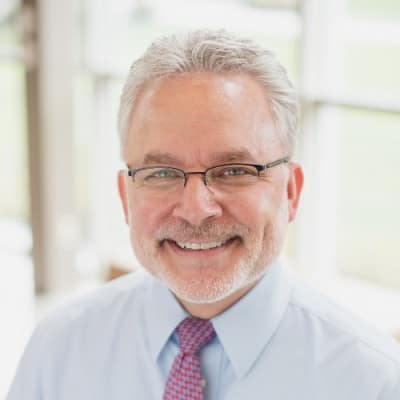
Dr. Michael Frank
Professor of Political Science
“Throughout his undergraduate career, he’s demonstrated this heart for helping people who are on the edges of the system, as it were,” said Dr. Frank. “As I think about students that we’ve had at AU, I think the ones that really excel in law school are those that are really thinking about, ‘How can I help my fellow human being?’ They’re looking at it as an opportunity for servant leadership, and Josiah certainly has that.”
Zaragoza hopes to one day use that servant leadership mindset in public office at the local or state level, then eventually in the federal government—and one day, perhaps, the Oval Office.

About Anderson University
Anderson University educates students for lives of faith and service, offering more than 50 undergraduate majors, 30 three-year degrees, 18 NCAA Division III intercollegiate sports, alongside adult, graduate, and online programs. The private, liberal arts institution is fully accredited and recognized for excellence in business, computer science, cybersecurity, engineering, music, nursing, psychology, social work, and teacher education programs. Established in 1917 in Anderson, Indiana, by the Church of God, the university remains committed to its Christ-centered mission.
